I routinely walk in the garden before it gets too hot. The breeze in the morning is gentle & the sun’s rays are soft, soothing. No many people are around & generally it is quiet.
In the evenings, it is chaotic. The swings are over crowded. The lawns are meeting grounds & some celebrate their birthdays.
The park is more accommodating than in the morning. But I am not. I prefer the morning chill. Am I a morning person? No. But I love the day break. The sun rising & if I have slept well, I can be a good companion.
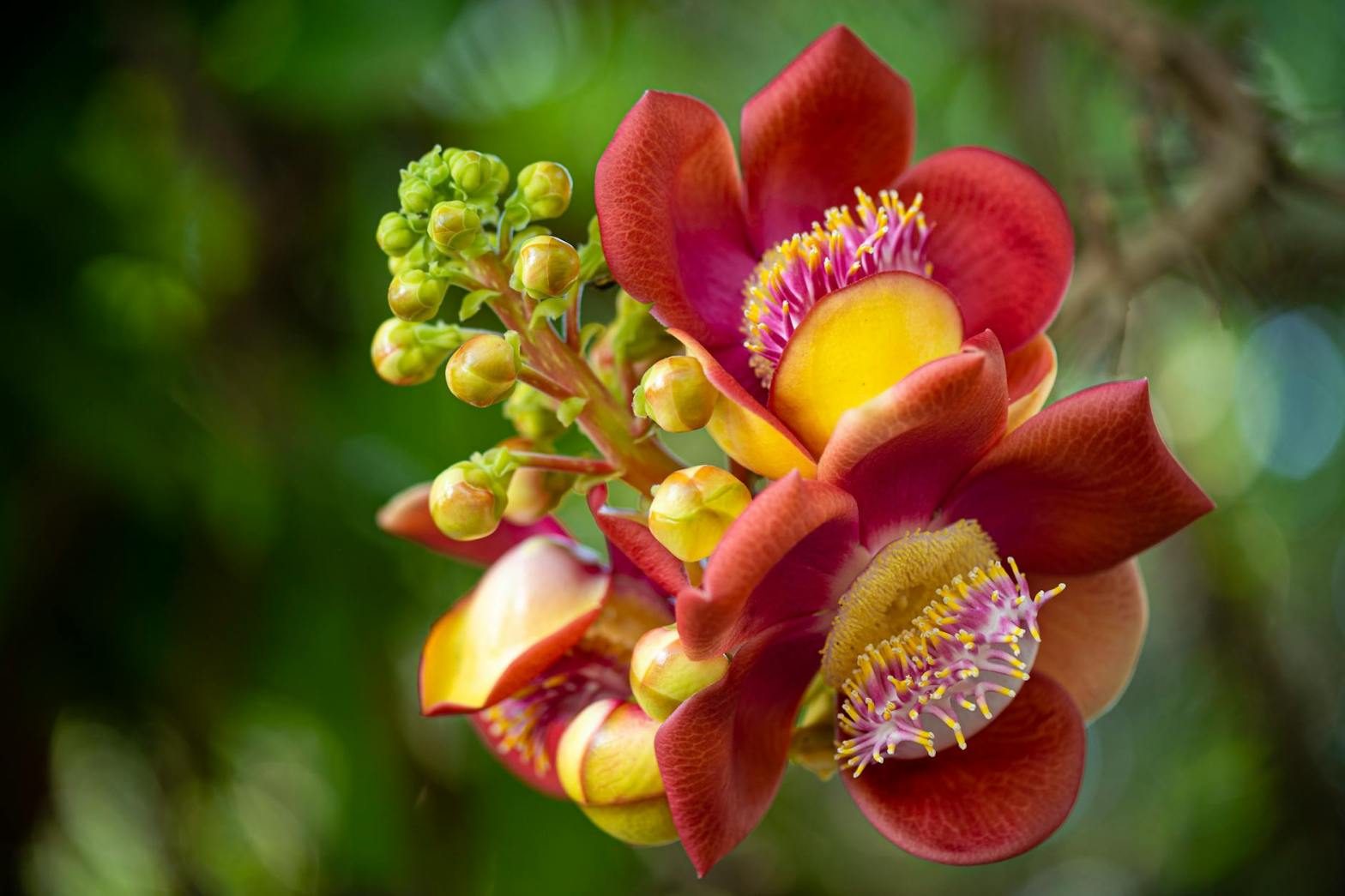
Recently, I came upon a tall tree laden with red flowers. Kailaspati tree ! Commonly known as the cannonball tree. It’s hooded flowers look like a naga under which the white stigma looks like a Lingam, and hence it is grown at Shiva temples.
The flowers are offered to Lord Shiva. The tree requires 12 years to bear flowers & fruits. Although rarely seen in gardens, one tree can hold as many as 1000 flowers per day. The flowers are strongly scented & especially fragrant at night & in the early mornings.
The fruits are spherical with a woody shell, giving the species the common name ‘cannonball tree’. One tree can bear 150 fruits at a time. Fruits take an year to mature in most areas.
Parts of the plant are used to treat hypertension, tumors, pain & inflammation, common cold, stomach ache, skin conditions & wounds, malaria & toothache, although data on it’s efficacy are lacking.
In Sri Lanka & India it was introduced by the British in 1881. It has been included as a common item in Buddhist temples as a result.
I collect the fallen flowers when I find them & offer to my Gods at home. I have yet to achieve a Monday, Lord Shiva’s day of worship but it is easy on other days.
 Asian Entertainment